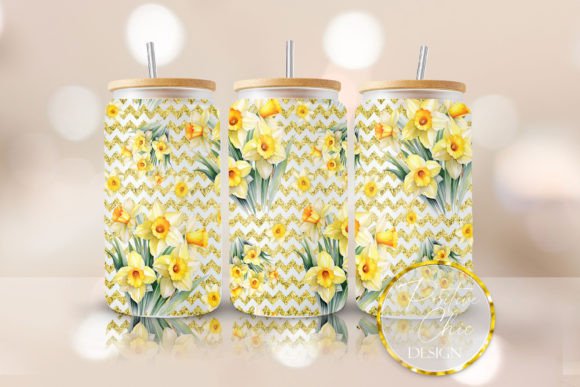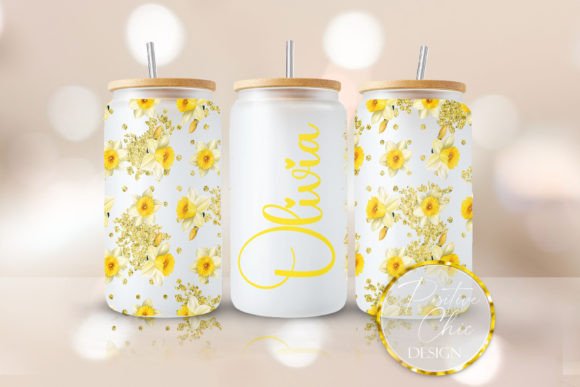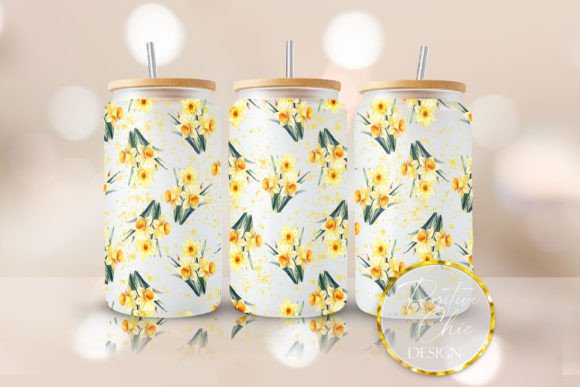
Daffodils Floral Libbey Glass Can Wrap
As a designer who’s stitched over 2,000 custom embroidery projects — from boutique baby onesies to holiday market tote bags and Etsy bestsellers — I opened Daffodils Floral Libbey Glass Can Wrap expecting floral charm, but what stood out immediately was its quiet intentionality. This isn’t just a pretty daffodil cluster; it’s a design calibrated for clarity, balance, and real-world stitchability — even if it was originally made for sublimation on a 16 oz Libbey glass tumbler.
First Impressions: Light, Lyrical, and Purpose-Built
The layout breathes. Three daffodils — one central bloom with two gently angled companions — sit within a soft, asymmetrical curve that mirrors the natural taper of a tumbler or the gentle drape of a tea towel edge. Petals aren’t fussy or hyper-detailed; they’re clean, slightly elongated, and spaced to avoid fill-stitch congestion. The leaves flow outward with subtle tapering — no abrupt cuts or jagged vector edges. That matters. In embroidery, every sharp turn or tiny loop becomes a potential thread break or jump stitch on low-density fabric.
This mood — hopeful, spring-fresh but not cutesy — lands perfectly for handmade products that aim for warmth without whimsy: a linen apron for a local bakery, a cotton baby blanket for a gender-neutral nursery, or a canvas tote for a botanical-themed small shop. It reads as intentional, not algorithm-generated.
How It Translates to Real Embroidery Projects
I tested Daffodils Floral Libbey Glass Can Wrap as a machine embroidery design on three base fabrics: medium-weight cotton twill (for tote bags), 100% combed cotton jersey (for sweatshirts), and lightweight linen (for pillow covers). Here’s what held up — and where caution is needed.
- Custom apparel & sweatshirt embroidery: Works beautifully when digitized with moderate stitch density and satin-stitched petals. The open negative space between blooms prevents bulk on fleece-backed sweatshirts — no puckering, no stiffness.
- Tote bag design & tea towels: Its natural arc aligns with the top seam of a standard 15”x15” tote or the folded hem of a kitchen towel. No awkward cropping or forced centering required.
- Baby embroidery & nursery decor: Gentle scale and organic flow make it ideal for onesies or crib bumper accents — especially when paired with soft pastel thread colors. Avoid dense fill stitches on thin interlock knits; opt for layered satin + running stitch outlines instead.
- Embroidered patch & cap embroidery: Not ideal straight-out-of-the-box. The curve doesn’t adapt well to rigid curved surfaces like structured caps without significant re-digitizing. For patches, reduce overall height by ~15% to maintain proportion at 3”–4” width.
Where to Proceed Thoughtfully
Daffodils Floral Libbey Glass Can Wrap shines in controlled, flat applications — but embroidery is rarely perfectly controlled. Keep these practical realities in mind:
- Hoop size & detail fidelity: If your hoop is under 4” in diameter, the outer daffodil may get clipped. Always check the bounding box before stitching.
- Textured or stretchy fabric: On slubbed linen or ribbed knit, use cutaway stabilizer + topping (e.g., water-soluble film) to prevent skipped stitches in petal curves.
- Dark fabric & thread contrast: The design relies on shape, not heavy outlines. Test thread colors in grayscale mockups first — yellow-on-navy works; pale gold-on-charcoal can disappear without a subtle outline stitch.
- Frequent-wash items: Avoid high-density fill areas near petal tips if stitching on baby bibs or kitchen towels. Opt for lighter fill + satin border for durability.
What It Adds — and What It Asks — of Your Brand
Used well, Daffodils Floral Libbey Glass Can Wrap elevates perceived value. Customers notice clean lines, balanced spacing, and thoughtful scale — cues they associate with professional craftsmanship. On an Etsy listing for personalized linen napkins, it signals care, not mass production. On a small shop’s embroidered apron, it quietly reinforces brand identity: grounded, seasonal, unhurried.
But it also asks something back: attention. It won’t mask poor stabilizing, mismatched thread tension, or rushed hooping. Its simplicity means flaws are visible — a stray jump stitch reads as error, not charm. That’s not a flaw in the design; it’s a feature. It rewards intention.
Designer Notes You’ll Actually Use
Before stitching your first Daffodils Floral Libbey Glass Can Wrap project, do this:
- Test on scrap fabric *with your exact stabilizer and thread* — not just similar, but identical.
- Check stitch density: if the original file feels heavy in software preview, reduce fill density by 10–15% for knits or lightweight weaves.
- Review small details in black-and-white mockup mode — does the center trumpet hold visual weight against the background?
- Confirm licensing terms: since it’s labeled a digital embroidery file for Crafts and Graphics, verify whether commercial use (e.g., selling finished embroidered totes on Etsy) is permitted without additional attribution or fees.
- Compare light/dark fabric renders side-by-side. Adjust underlay or add a single-outline layer if needed for definition on charcoal or navy.
Finally, remember this: Daffodils Floral Libbey Glass Can Wrap isn’t just a graphic. It’s a starting point — one that respects the craft behind the stitch. Whether you’re prepping for a craft fair, building a cohesive line of spring-themed handmade products, or sourcing reliable design assets for client work, its strength lies in how quietly it supports your voice, rather than shouting over it.
That kind of restraint? That’s rare. And worth stitching carefully.